Chapter by Chapter commentary on LILA, an Inquiry into Morals by Robert Pirsig
The Metaphysics of Quality explained

Preface
My intent
It is my intent to make an effort to bring the power of the metaphysics of Quality (MoQ) and its usefulness to the attention of a broad public. The Metaphysics of Quality is a framework through which to view the world and the complexities of our daily experience. I have found it to be a strong meta theory which allows us to make complex considerations and reach well constructed judgements on all manner of subjects. In chapter 13 of LILA Pirsig states;
“The Metaphysics of Quality explains more of the world and it explains it better.”
Two complex stories - focus on the Metaphysics of Quality
The book LILA contains two stories that are intertwined. One story is the development, construction and explanation of the Metaphysics of Quality. The other story is the complex interactions between Pirsig and his travel companion Lila. In this reading, to reduce complexity and in the interest of my above mentioned intent, I will focus on the first story and minimise discussions of the interactions with Lila.
Transforming the MoQ from a theory to an analytical tool
LILA is a beautiful novel that introduces the MoQ as a philosophy. The MoQ can be interpreted as a metaphysical truth claim, a moral framework, a diagnostic tool, a decision methodology or a language for describing value conflicts. With thoughtful application it can offer a disciplined way to reveal structures of conflict that other frameworks obscure.
It is my opinion that we, in the Robert Pirsig community, primarily emphasise the pursuit of metaphysical truth. I will endeavour to promote the diagnostic tool and decision methodology aspects of the MoQ. It is my intent to clarify and extend the MoQ and transform it into a usable analytical tool. I then intend to apply the MoQ to common situations, write case studies and so demonstrate its usefulness.
With that as a background I am happy to offer a chapter by chapter interpretation of LILA.
Ton Coumans
___________________________________________________________________
LILA
an Inquiry into Morals
Contents
Setting the tone
Organising his thoughts
Dusenberry and Indian culture
William Sidis
5.1 Metaphysics
5.2 Degeneracy and decay
6. Breakfast with a lecture on morality
7. Sailing toward New York
8. First of the three main concepts of the MoQ
9. Second of the three main concepts of the MoQ
10. Rivers and sewers
11. The Carbon atom - inorganic value patterns
12. Third of the three main concepts of the MoQ
13. The MoQ applied
14. The interview
15. Value within the organic (biological) level - Sex with Lila
16. Lila takes Pirsig to meet an old friend
17. Value within the social level - a walk through New York
18. Lila in New York
19. Meeting Robert Redford
20. Celebrity and social value patterns
21. The Victorians
22. The post Victorian chaos
23. Lila in a bad state
24. Analyses of modern America - sixth law of the MoQ
25. Pirsig returns to the boat
26. William James and insanity
27. Escape to Sandy Hook
28. Motoring and sailing to Horseshoe Cove
29. More William James and insanity
30. Going for Groceries
31. Lila Leaves
32. Conclusion
Chapter 1 - Setting the tone
It is a mystery to me how someone that is so analytically intelligent can also be such a masterful writer. In the first few paragraphs Pirsig sets the tone for the whole book. And for years the tone of the book has had me distressed. I never enjoyed reading LILA, by that I mean the travelogue. The parts where he explains the MoQ are fascinating and that is an understatement. So why the enormous contrast in the two story lines? I think I have finally figured it out. It is something that had slipped my attention for years. There is a remark in chapter 5 of the book that offers an explanation and transforms my anguish with the travelogue to acceptance of it.
Zen and the Art of Motorcycle Maintenance (ZAMM) is an uplifting book where Pirsig is obsessed with the search of what is good and what is real. The tone in LILA could not be more different. The whole story reeks of….. decay. Is it a coincidence that the story plays in the late fall with winter setting in?
Pirsig is around his early sixties in the book. In the opening of the book, on the very first page Pirsig shares with us how he got boozed up at a bar and picked up Lila, brought her back to his boat and had sex with her. About the next morning he writes;
“When Lila’s eyes opened in a hung-over daze she’d look into the features of a grey haired man she wouldn’t even remember - someone she met in a bar the previous night. Her nausea and headache might produce some remorse and self-contempt but not much, he thought - she’d been through this many times…”
Nausea, remorse, self-contempt. These are the words of choice for the first page and this tone continues through out the book. I will refer back to these words from time to time throughout this commentary on LILA. Remember from ZAMM that Pirsig passionately explained that care and quality are each others internal and external counterparts? Not much of that vibe to be found in this book. Pirsig writes;
“After enough ale everything got reduced to biology, where it belonged.”
The words “reduced to” say so much about the tone of the travelogue. It would not surprise me if many people did not finish the book for this reason. But the great gift of LILA emerges when Pirsig puts together the Metaphysics of Quality starting in chapter 8. It is so profoundly fascinating that it rises above, or maybe rises out of the decay of the travelogue. The contrast of the two is massive so we trudge on to the prize.
Chapter 2 - Organising his thoughts
Pirsig wakes up early and realises Lila is in the berth next to him. Because she is blocking his access to the door he decides to exit, stark naked, though the open hatch on to the deck of the boat where he is immediately hit by the cold air. After peeing off the side of the boat he eventually circles back into the boat from the main hatch and settles into the cabin. Pirsig is such a natural writer that you have no problem building a picture in your mind of the see and feel of the boat. There are many details that are very symbolic.
Pirsig then explains that he is working on the MoQ and is organising his thoughts using slips of paper and trays to hold the slips. Very interesting reading. He finishes by introducing his friend Dusenberry who had strong contacts with American Indians and spend almost all his spare time with them.
Chapter 3 - Dusenberry and Indian culture
Pirsig was preparing to write a follow up book to Zen and the Art of Motorcycle Maintenance and for a long time he thought the back bone of the book would be North American Indian traditions and how they influenced American culture. As time past and his research deepened this approach faded as a usable central theme for his book. Still, his train of thought is valuable so he includes his early thoughts in this chapter. It is a beautiful and thought provoking read. Pirsig expands on his friendship with Dusenberry and describes an Indian spiritual ceremony he attended on the reservation. Toward the end of the chapter Pirsig draws a number of conclusions I take issue with but no need to elaborate on these because these have no direct relationship to the MoQ. In an indirect way the study of Indians had a profound impact on the MoQ.
While studying Indian culture Pirsig read an account of affairs concerning the Zuni Indian tribe. This specific story lead him to a break through concept that became one of the three central concepts of the MoQ. So studying the American Indians turned out to produce a serendipitous return.
Also, Dusenberry wished to pursue PhD studies with the Indians as subject. But he refused to accept objectivity as an anthropological criterion because, he argued..
“The trouble with the objective approach is that you don’t learn much that way…..”
The MoQ addresses this issue and provides a powerful alternative to strictly objective thought constructions.
Chapter 4 - William Sidis
Pirsig visits the Indians but was never able to establish the kind of connection Dusenberry had. So instead he collected all the books on Indian culture and drove his truck camper up into the mountains to read all anthropological writings on the Indians. This produced a dead end but at least he achieved clarity. Pirsig became aware that he would not be taken seriously in the anthropological community because he, much like Dusenberry, would not conform to the objective, scientific approach that was mandatory in this community. The chapter finishes with the incredible story of William Sidis who possibly had the highest intelligence ever observed. He lived from 1898 to 1947 and at the age of 8 years old he passed the entrance exam for Harvard University. Later in life he had been studying the influence of Indian culture on American culture which stunned Pirsig when he discovered this.
Pirsig in this chapter reconfirms for himself that objectivity, as it is treated in our current modes of rationality, hinders knowledge formation in many aspects of human experience. Objectivity illuminates some domains while obscuring others.
Chapter 5.1 - Metaphysics
(I will discuss Chapter 5 in two different sections; 5.1 and 5.2)
Pirsig reaches the conclusion that it is useless to enter into the field of anthropology because of his objections to the methods of research used in that field of study.
“The solution to the anthropological blockage was ….. to first find some solid ground upon which a structure can be constructed. It was this conclusion that placed him … in the field of philosophy known as metaphysics.
Pirsig then elaborates on what metaphysics is understood to be.
“Aristotle; that part of philosophy which deals with the nature and structure of reality.”
Typical questions addressed in metaphysics are….
“Are the objects we perceive real or illusory?”
“Does the external world exist apart from our consciousness of it?”
“Is reality ultimately reducible to a single underlying substance?”
“If so, is it essentially spiritual or material?”
“is the universe intelligible and orderly or incomprehensible and chaotic?”
Pirsig also explains that there are two schools of thought that do not accept that metaphysics as a legitimate body of knowledge.
“The first are the philosophers of science… known as logical positivists, who say that only the natural sciences can legitimately investigate the nature of reality, and that metaphysics is simply a collection of unprovable assertions… For a true understanding of reality metaphysics is to ‘Mystical’.”
“The second group of opponents are the mystics….. Historically mystics have claimed that for a true understanding of reality metaphysics is too “scientific”. Metaphysics is not reality. Metaphysics is names about reality. Mystics will tell you that once you open the door to metaphysics you can say good-bye to any genuine understanding of reality. Thought is not a path to reality.”
What a wise approach by Pirsig to identify the two schools of thought that will oppose his effort to develop a metaphysics of Quality. He goes on to refute both opponents. To the Mystics that wish to uphold the purity of reality he states…
“Purity, identified, ceases to be purity. Objections to pollution are a form of pollution.”
Pirsig concludes that there is an intellectual compulsion to engage in writing metaphysics, and so he does. To the logical positivists he says…
“…that values are the essence of experience. Values are more empirical, in fact, than subjects or objects.”
Useful chapter to describe what metaphysics is and what the counter arguments to metaphysics are.
Chapter 5.2 - Degeneracy and decay
In this chapter Pirsig expands on the line of thinking that the mystics follow. He places himself before a dilemma; ‘To define Quality or not to Define Quality, that is the question’……… Shakespeare might have pondered.
“What made this so formidable to Phaedrus was that he himself had insisted in his first book that Quality can not be defined. Yet here he was about to define it. Was this some kind of sell out?……To define something is to subordinate it to a tangle of intellectual relationships. And when you do that you destroy real understanding.”
This is clearly tearing Pirsig apart. But he can’t help himself, he is compelled to do it even if that means tarnishing himself and creating something that will, by the understanding of mystics, always be something that is less than reality itself. He realises this fully and yet is compelled to proceed. He explains;
“A metaphysics must be divisible, definable and knowable, or there isn’t any metaphysics.”
“To the intellect the process of defining Quality has a compulsive quality of its own. It produces a certain excitement even though it leaves a hangover afterward…like a party that lasted too long… or like Lila last night.”
And then Pirsig states…
“Writing a metaphysics is, in the strictest mystic sense, a degenerate activity.”
That’s it! When Pirsig writes the metaphysics of Quality, he is in fact engaging in a degenerative activity according to the mystics.
Is that then the reason that the travelogue reeks of decay? Did Pirsig consciously make the travelogue a tale of degeneracy to parallel his activities of writing a metaphysics? Is this his way to acknowledge the position of the mystics? In his first book Pirsig sided with the mystics and refused to define Quality. Now, reluctantly, he proceeds to structure his concept of Quality.
In chapter 32 of this book he reflects on this again.
“Strictly speaking, the creation of any metaphysics is an immoral act since it’s a lower form of evolution, intellect, trying to devour a higher mystic one. It is wrong when a metaphysics tries to devour the world intellectually. It attempts to capture the Dynamic within a static pattern. But it never does. You never get it right. So why try?”
For me, this explanation is to elegant to dismiss. It puts me at ease with the travelogue. This is an excellent reason to no longer try to find meaning in details of the travelogue that express the degeneracy in all the interactions Pirsig has with Lila, Rigel, Capello, Redford and all the other characters that pass the revue in the travelogue. What a relief.
But then again, that might not be fair. I am grasping at an easy way out and that does a disservice to the book. I struggle with the interactions between Lila and Pirsig but they are indeed ‘functional’ to the context of the book and degeneracy in the context of the MoQ should not be equated with ‘wrong’. The interactions are psychologically deeply meaningful but it puts a strain on the reader at the expense of contemplating the MoQ. A reader could maybe benefit from the following strategy; read LILA first with a focus on the MoQ, possibly by using this writing as a guide. Then re-read the book to interpret the interactions with Lila.
The MoQ can be interpreted as a metaphysical truth claim, a moral framework, a diagnostic tool, a decision methodology or a language for describing value conflicts. With thoughtful application it can offer a disciplined way to reveal structures of conflict that other frameworks obscure.
I choose to focus on the ‘diagnostic tool’ and ‘decision methodology’ characteristic of the MoQ and for that it suits me to minimise the discussion of the interactions with Lila.
Chapter 6 - Breakfast with a lecture on morality
In this chapter we are back on the boat and the travelogue continues. This is the first of the chapters where the ‘nausea, remorse and self-contempt’ accompanying the degenerate activity of writing a metaphysics described in chapter 1 is on display. Rigel is the captain of a boat Pirsig is moored to in the harbour. Rigel knows Lila from childhood. He warned Pirsig to stay away from Lila but Pirsig ignored this and hooked up with Lila anyway. The next morning Rigel suggest they have breakfast together without Lila so they can talk. Rigel is not happy that Pirsig ignored his warning and delivers a sermon on social codes and morality. It is a chapter with a lot of arguments, anger, frustration, accusations and misunderstandings.
In his first book Pirsig used motorcycle maintenance as a vehicle to explain different aspects of rationality and the concept of Quality he was developing. In this book, Pirsig is using his spontaneous travel companion Lila to explain the intricacies of the MoQ. He is using the MoQ to “understand” Lila. Pirsig is analysing her physical being, her state of mind and her behaviour in society using his new insight; the MoQ. That makes exciting reading but it is possibly the most complex case study to choose to explain the MoQ with. It can be confusing and is probably not helpful for my goal.
I hope to provide readers with a low threshold introduction to the MoQ and a start to applying it. I wish to create a coherent, accessible and learnable description of the MoQ. Then, starting with simple case examples allow readers to experience the power of the MoQ. The very complex interactions with Lila are not helpful here and so I will not emphasise them.
At the end of the chapter Rigel asks Pirsig; “does Lila have quality?” which to me is a nonsensical question. However, Pirsig agonises over this question which I find strange and he comes back to it repeatedly in the book. Overall a negative feel to the chapter. Degeneracy.
Chapter 7 - Sailing toward New York
The boat is on the move again sailing down the Hudson river. The first part of the chapter is the interaction between Pirsig and Lila and reflects the nausea, remorse and self-contempt accompanying the degenerate activity of writing a metaphysics. Pirsig has had breakfast of course but Lila is hungry and there is no food on the boat. Does Pirsig care? She finds half a chocolate bar but it is old and stale. The interactions between Pirsig and Lila are contemptuous.
In the second half of the chapter Pirsig reflects on the Victorian culture that ruled this part of America in the late eighteen hundreds and early nineteen hundreds. Using the Victorians he shows how social value patterns rule the boundaries within which an individual will need to operate to receive the benefits of membership of that society. He also points out the rigidity of such patterns, even past the point that they are of any benefit to the average member of society. They also can prevent a society from progressing. Pirsig makes the analogy between ornamental cast iron furniture and Victorian social norms and values. Cast iron is stiff, uncomfortable and shatters when struck at. Victorian social norms got smashed in WWI when a whole generation of men were send to defend those norms but ended up dying in the trenches…… “on Flanders fields”.
Pirsig gives an illustration of the relation between social value patterns of the Victorians and members of that society. This is case study he can refer back to after having explained the MoQ.
Chapter 8 - First of the three main concepts of the MoQ
In the next six chapters Pirsig will lay out his MoQ. But before doing so he introduces a metric with which to judge his own creation. Pirsig states;
“The tests of truth are (1) logical consistency, (2) agreement with experience and (3) economy of explanation. The MoQ satisfies these.”
This is the first chapter that explains the first of three main concepts of the MoQ. Students of the MoQ should read the whole chapter. I will split the summary of this chapter into two parts, the basics and advanced reading.
The Basics
The first concept of the MoQ deals with the nature of matter or substance. It is the most fundamental of the three main concepts in that it places the greatest appeal on our power of visualisation. It forces us to flip on its head a basic assumption we hold. Now, using our power of our visualisation, the first Law of MoQ states;
First Law of the MoQ; “The world is composed of nothing but (moral) values”.
(The word ‘moral’ can be confusing and is explained chapter 12. Until further explanation it can be disregarded.)
We need to make a mental shift in order to embrace the MoQ. It is normal for us to believe that an object is real, and that quality (value) is an attribute of that object that tells us something about the object or substance. The MoQ turns that around and states….
“A thing that has no value, does not exist. The thing has not created the value. The value has created the thing.”
That implies that quality is real and creates our perceived world. What we detect with our senses are qualities. Our senses detect values. Therefor value (quality) creates the object.
“…Quality or excellence is seen as the ultimate reality.”
Now, for this presentation of affairs to be more than just semantics it is necessary to establish what the benefits could be. Pirsig writes…
“The greatest benefit of this substitution of ‘value’ for….. ‘substance’ is that it allows an integration of physical science with other areas of experience that have been traditionally considered outside the scope of scientific thought.”
This is the basic description of the first concept. Pirsig articulates the problem that this first concept solves in our current way of thinking;
“This problem of trying to describe value in terms of substance has been the problem of a smaller container trying to contain a larger one. Value is not a subspecies of substance. Substance is a subspecies of value. When you reverse the containment process and define substance in terms of value the mystery disappears: substance is a stable pattern of inorganic values. The problem then disappears. The world of objects and the world of values is unified.”
Although this is the most fundamental concept of the MoQ, it is also the one that, in practice, plays a role in the background. Pirsig’s vision of the MoQ is practical in that he acknowledges that we will not involve values in every form of discourse. We will not say; please hand me the rod shaped thing of about 12cm length that draws a line of ink when its point is dragged alone a surface. We will of course continue to say; please hand me the pen. But we can also realise at the same time that it is values that have created the pen. This is similar to the use of two dimensional maps of a spherical world or of a mountainous region. Flat maps are practical but we realise that it is merely a representation of reality that is actually three dimensional. Also, in chapter 11 Pirsig extensively discusses the properties of the carbon atom. He uses “carbon atom” as a handle to allow him to refer to the value patterns that manifest themselves in what we call the carbon atom.
Advanced reading, philosophical exploration (consult the book)
Having established that values are the ultimate reality, Pirsig goes on to discuss how this relates to a number of topics.
Pirsig assesses that the MoQ subscribes to what is called empiricism, but then expands on it.
The MoQ does not insist on a single exclusive truth. The MoQ allows one to seek instead the highest quality intellectual explanation of things.
Scientific reality; should reality be something that only a handful of the world’s most advanced scientists understand? In the MoQ, reality, which is value, is understood by every infant.
The interpretation of causation in the MoQ is explained.
And finally;
“Pirsig found again and again that a Quality-centred map of the universe provides overwhelming clarity of explanation where all has been fog before.”
Chapter 9 - Second of the three main concepts of the MoQ
This chapter explains the second of three main concepts of the MoQ. Students of the MoQ should read the whole chapter, study it in full and not rely on this summary.
If the world is composed of nothing but values as Pirsig states, how is that useful to us? If we accept that Quality is the ultimate reality, how does that enable us to fulfil our urge to create “a simplified and intelligible picture of the world” as Einstein remarked. How do we operationalise this to help us shape our actions in the real world of our daily lives? The second law of the MoQ takes the fist step.
Second Law of the MoQ; The whole spectrum of reality as experienced and interpreted can be described by Static Quality and Dynamic Quality that are mutually exclusive and work as each others counterparts.
Pirsig writes;
“This first division of the Metaphysics of Quality now covered the [whole] spectrum of experience, from primitive mysticism to quantum mechanics”
The definitions are given below but these are complex concepts and to get a good understanding it is advisable to study the chapter in full.
Dynamic Quality can not be defined. Pirsig writes;
“Dynamic Quality is the pre-intellectual cutting edge of reality, the source of all things, completely simple and always new……. It contains no pattern of fixed rewards and punishments. Its’ only perceived good is freedom and its’ only perceived evil is static quality itself - any pattern of one sided fixed values that tries to contain and kill the ongoing free force of life.”
From Zen and the Art of Motorcycle Maintenance;
“It is the continuing stimulus which causes us to create the world we live in.”
Dynamic Quality is not simply change. Perceivable change can be the product of Dynamic Quality, but that is not the same. When Dynamic Quality manifests itself in a person it is experienced as an ‘urge’ or continuing stimulus of some kind. When A.N. Whitehead wrote;
“Man is driven forth by dim apprehension of things to obscure for his existing language”
…..he was writing about Dynamic Quality.
But Dynamic Quality is not just a human urge, it also manifests itself in every area of human experience; from a meteor slamming into the moon and creating a crater to a person that has an “ah-ha” moment and invents a new idea. It is everywhere.
Static Quality is Dynamic Quality’s counter part. It is all the area of human experience that can be described and discussed.
“Static Quality……. emerges in the wake of Dynamic Quality. It is old and complex. It always contains a component of memory. Good is conformity to an established pattern of fixed values and value objects….. Static morality is full of heroes and villains, loves and hatreds, carrots and sticks. Its values don’t change by themselves. Unless they are altered by Dynamic Quality they say the same thing year after year.”
Life can not exist without Dynamic Quality and Static Quality working in tandem. Entropy can not be reversed without the two working simultaneously.
In his first book Pirsig struggled with the situation that he was convinced that Quality should not be defined. But this left him with nothing to talk about. Something that is not defined can not be discussed in a rational way. It becomes a mystic entity such as, for instance, the Buddha. But Pirsig wanted to talk about Quality in a rational way and he felt there was an enormous depth of understanding to be found behind the word quality, a word that we thoughtlessly toss out in discussion. This antagonised him deeply in his first book. Possibly it could be the factor that contributed most to his lapse into insanity, or declared insanity.
In the MoQ, with one master stroke of the analytical knife, Pirsig defeats the Gordian knot that tormented him. By splitting the reality of values into an undefinable Dynamic Quality and a definable Stable Quality he created a framework that allowed the concept to be engaged rationally. This must have been an enormous liberation for him. Amazing what one single idea can bring about.
Chapter 10 - Rivers are sewers
A chapter with a lot of symbolism and the feeling of nausea, remorse and self-contempt accompanying the degenerate activity of writing a metaphysics. For instance; there is a lot of debris in the water and the book gives a vivid description of the stinking corps of a dead dog floating past the boat. Pirsig says that all the debris is floating down the river….
“These rivers are like sewers. They take all the debris and poisons from the land and carry them out to sea”
Does he possibly mean that they themselves are part of the debris? It is just amazing how Pirsig can switch between philosophical concepts in the high country of the mind to writing about intense human interactions between two people who are on completely different wave lengths. Lila tries to share something she is passionate about but Pirsig is dismissive of it, calls it prostitution. Lila is reaching out to make a connection and he is just rude, or at best living in his own world and expressing his unfiltered opinions. There is a lot of symbolism in this chapter but I don’t enjoy reading it. The lack of empathy disturbs me.
Chapter 11 - The Carbon atom - inorganic value patterns
To appreciate this chapter you will preferably have a degree in physics and be knowledgable on thermodynamics and the theory of evolution.
The second law of thermodynamics states; all systems run down. But life (evolution) runs up and continues to become more and more complex. How can this be? This is a question that has puzzled scientists for a long time. Pirsig goes on to apply the Dynamic Quality - Stable Quality concept at the level of the carbon atom and explores how the concept of Dynamic and Stable Quality could be a basis of explaining how entropy is reversed. He considers a living cell and identifies the DNA as the Dynamic element that is surrounded and protected by stable proteins that represent the static quality. The two need each other to sustain life. It is beyond the scope of my expertise to expand on this but it sounds very interesting.
There is however one statement I need to address. Pirsig at one point states….
“All life is a migration of static patterns of quality towards Dynamic Quality.”
I have to take issue with this statement. Masterful writers can sometimes produce sentences that are smooth and sound impressive but when analysed offer little substance. When I read “life is migrating”, to me that means that life is on the move and has a sense of direction. Pirsig tells us that life is gravitating toward Dynamic Quality. However, Dynamic Quality is undefined and unknowable, so how can there be gravitational pull by Dynamic Quality? What is this smooth statement telling us?
As I might have expected this phrase has been analyse by many readers of LILA and AI systems have access to all this analyses. ChatGPT reproduced these insights and rephrased the statement to make it more accurate.
ChatGPT translation; “Life manifests as static patterns that are continually ‘selected’ or stabilised after interactions with Dynamic Quality”
Toward the end of the chapter Pirsig makes more statements on this topic.
“Evolution can’t be a continuous forward movement. It must be a process of rachetlike steps in which there is Dynamic movement forward up some new incline and then, if the result looks successful, a static latching on of the gain that has been made; then another Dynamic advance, then another static latch.”
In this description it is Dynamic Quality that initiates the migration forward and stable quality is able to hold on to the move. Although the word forward is used here I question if Dynamic Quality can have a sense of direction. Isn’t Dynamic Quality just random flux and isn’t it Static Quality that holds on to what is good?
There is debate on this topic but I side with the randomness of Dynamic Quality.
“Sometimes a Dynamic increment goes forward but can find no latching
mechanism and so fails and slips back to a previous latched position. Whole species and cultures get lost this way. Sometimes a static pattern becomes so powerful it prohibits any Dynamic moves forward. In both cases the evolutionary process is halted for a while.”
The last two phrases make sense to me and connect with the ChatGTP interpretation. They seem to fit into all other concepts of the MoQ so I am happy to embrace these explanations. I will work with the last two phrases.
Finally, Pirsig returns to the question ‘Does Lila have quality?’ and agonises over it. His ponderings baffle me.
Chapter 12 + parts of 13 - Third of the three main concepts of the MoQ
This chapter explains the third of three main concepts of the MoQ. Students of the MoQ are advised to read the whole chapter. I will split the summary of this chapter into two parts, the basics and advanced reading.
The Basics
Pirsig realised that the values that hold together a glass of water are not the same as the values that hold together a society. This leads to the third law of the Metaphysics of Quality;
Third Law of MoQ; Static patterns of value are divided into a hierarchy (based on evolution) of four systems; inorganic patterns, organic patterns, social patterns and intellectual patterns.
“These four patterns are exhaustive. They cover the whole known world. No thing is left out. Only Dynamic Quality, that can not be defined, is absent.”
Some characteristics;
1. The levels are not continuous, they are discrete. They have very little to do with one another.
2. Although each higher level is built on a lower one it is not an extension of that lower level. Quite the contrary. The higher level can be seen to be in opposition to lower level, domination it, controlling it where possible for its own purposes.
3. Values apply by level. The values that hold together a glass of water are inorganic value patterns. The values that hold together a nation are social value patterns.
4. Biological, social and intellectual value patterns are not an extension of matter (inorganic value patterns).
5. Evolution of static value patterns runs from inorganic value patterns (low) to intellectual value patterns (high).
6. The MoQ argues that everything is an ethical activity. Hydrogen and oxygen form water because it is moral to do so. When atoms (inorganic value patterns) create life, they do so because it is “better”. This is the direction of evolution.
7. The MoQ states that if moral judgements are essentially assertions of value and if value is the fundamental ground stuff of the world, then moral judgements are the fundamental ground stuff of the world. Therefor, the world is composed of nothing but moral values. (This is the explanation of the word moral as it is expressed in the first law of the MoQ. In practice and in discussions about the MoQ the word “moral” is seldom used. It has proven sufficient to just speak of values.)
9. Each level of static value patterns contains its own moral system (historical purpose). This should be seen as the “existential” morality (historical purpose) of the level. Inorganic value patterns struggle to achieve and maintain stability and triumph over the forces of chaos. Organic value patterns struggle to stave of (triumph over) starvation and death. Social value patterns triumph over organic value patterns by coercing them into behaviour that ensures the survival of the social value pattern and in turn enhances the survivability of its members. Intellectual value patterns dominate social value patterns by “injecting” into society ideas (Dynamic Quality) that enhance the viability, development and progress of that society.
This leads to the fourth and fifth Laws of the MoQ.
Fourth Law of the MoQ; A higher evolutionary form of static value pattern enjoys moral precedence over a lower form of evolutionary static value pattern.
Fifth Law of the MoQ; Dynamic Quality enjoys moral precedence over Static Quality, but unrestrained Dynamic Quality results in chaos and decay of static value patterns and thus to devolution.
The fifth law implies that Static Quality must interact with Dynamic Quality to make evolution possible.
Advanced reading, philosophical exploration (consult the book)
* Mind versus matter
Pirsig is able to shed light on and provide clarity on the mind versus matter puzzle by applying the MoQ.
* Free will versus determinism
Pirsig follows a chain of thought that if a person has a free will and a person is made of atoms, then atoms can also have the property of choice. This possible fallacy of composition is deliberately provocative, meant to challenge reductionist thinking and open the door to Pirsig’s idea that value (and something like “choice”) is fundamental to reality.
The following sentence is not well explained in this chapter but is further discussed in chapter 24 and is important to the application of the MoQ.
“A primary goal of every level of evolution seems to be offering freedom to lower levels of evolution. But as the higher level gets more sophisticated it goes off on purposes of its own.”
There is a problem with this phrase. Pirsig writes philosophically but not in a strictly academic style. He prioritises insight and experience over tight definitions. As mentioned above, this aspect of the MoQ will be dealt with in depth in chapter 24 including the formulation of the sixth Law of the MoQ.
Chapter 13 - The MoQ applied
Having constructed the MoQ, Pirsig now uses this chapter to apply the theory to several different moral queries. This demonstrates the power of the MoQ and brings to life the benefits it offers. Pirsig explains;
“We are at last dealing with morals on the basis of reason. We can now deduce codes based on evolution that analyse moral arguments with greater precision than before.”
We currently work with moral codes that are social conventions. Things we believe in. But we can now rationally deduce from the MoQ what a moral judgement should be. Here are some examples that Pirsig discusses.
Consider a germ and a patient. The germ wants to live and the patient wants to live. From the Forth Law of the MoQ one can deduce that it is morally correct for a doctor to kill the germ and save the patient because a human is at a higher level of evolution than a germ. This moral determination now has a rational basis. In one case we have actually gone further than curing a single infection. In the case of smallpox, this disease has been completely eradicated. The germ no longer exists and the world is a better place for it. This is an easy type of example to get started because intuitively everyone will agree.
Consider the Guinea worm disease (dracunculiasis). This is a parasitic worm that is exclusively hosted by humans. Bill Gates has taken it upon himself to eradicate this worm. There is no vaccine or medicine for Guinea worm. Eradication is accomplished through community education, filtering drinking water, and “controlled immersion” (a technique where workers treat the wound by soaking it) to stop transmission. Cases dropped from 3.5 million annually in the 1980s to just 13 in 2023, bringing the disease to the verge of complete eradication. This has lead to debates if it is moral to eradicate part of “God’s creation”. This is farcical because the only way the worm can survive is by infecting a human. Which human will volunteer to host the worm to prevent its extinction? Interestingly, what this example shines a light on is the following; We are not bothered by the extinction of the smallpox virus. But a worm is a higher form of evolution and now extinction has us pondering the loss of diversity, or in the terms of the MoQ; the lost of a unique intellectual value pattern*. Intellectual value patterns have the highest moral precedence. Is it moral for a social value pattern to kill and intellectual value pattern? Regardless of the answer, this discussion demonstrates the enormous power of the MoQ as a framework with which to analyse all manner of subjects. * The death of a single worm is the loss of an organic value pattern. Extinction of the worm is the loss of an intellectual value pattern.
Is vegetarianism moral? Hindus follow a religious social convention that dictates it is not moral to eat the flesh of animals. However, deducing from the Forth Law of the MoQ one can conclude that it is not immoral because an animal is on a lower level of evolution than a human. However, it is more moral to be a vegetarian because a vegetarian is sustaining life while consuming plant based food which is of a lower evolutionary level. But what should a Hindu do in times of a famine? The MoQ concludes that it would be moral to eat the cow to allow the human to survive. This example invites more discussion but again, the theory still stands.
is Freedom of speech moral? We all agree that free speech it is good, but that is just a social convention. There are essays and books that argue in favour of freedom of speech, but those are just arguments. The MoQ offers a framework that allows for a better interpretation of the question. The intellectual level has moral precedence over the social level. The morality of the intellectual level is to inject ideas into society (Dynamic Quality) that enhance the viability, development and progress of that society. To allow an idea to circulate in society, freedom of speech is imperative and therefor freedom of speech is moral. Interestingly, the creator of the idea is a human, a member of the society. Shuji Nakamura invented blue LED light and society rewarded him with the Nobel Prise in Physics. Copernicus proposed a new model for our solar system and was forced to flee from prosecution. The social level has moral precedence over its members that are of the organic level.
Is it moral for a society to kill one of its members? A society has moral precedence over an individual in accordance with the Forth Law of the MoQ because a society is a higher level of evolution than a single individual. So if a society condemns an individual to death the MoQ provides a moral basis to do so. However, with this case we enter the area where circumstances and trade offs need to be considered. If a society is at peace or at war can be an important consideration. Also, killing an individual can weaken a society. An individual is a thinking being and is therefor a source of intellectual value patterns which have moral precedence over social value patterns. Imagine if Nelson Mandela had been executed. Pirsig expands in depth on this case in the book.
I remember reading LILA for the first time and being either disappointed or confused by chapters 1 through 12. However, chapter 13 completely changed that and the power of the MoQ became clear to me. I would invite the reader to practice applying the MoQ and discovering its usefulness. Pirsig noted that….
“Where ever he looked, whatever examples came to mind, he always seem to be able to lay them out in this framework, [the MOQ] and the nature of the conflicts usually seemed to be clearer when he did so.”
I have had the same experience. I would like to offer some examples of my own, not drawn from the book. I would like to add some applications that refer more to the First Law of the MoQ which states that the world is composed of nothing but (moral) values. This is a fundamental level. If the MoQ is broadly adopted it should also have influence on the the way we formulate definitions. I will make a first attempt at some definitions. Let us consider a number of definitions from the Cambridge Dictionary and compare them to what the definition would be under the MoQ. Let us start with the word science.
Science - American Dictionary; (from Cambridge Dictionary)
The systematic study of the structure and behavior of the natural and physical world, or knowledge obtained about the world by watching it carefully and experimenting.
Science - The MoQ
The systematic study of stable inorganic and biological value patterns with the aim of formulating explanatory intellectual value patterns.
Biological value patterns (such as a blood cell) are a sub set of organic value patterns and are those organic value patterns that do not have a central nervous system.
The reason the MoQ definition is better is because it is more specific of what the outcome should be, not just any knowledge but an intellectual value pattern that is explanatory. The inclusion of value in the definition enhances its meaning. It is also more explicit in the areas to be studied, by the virtue of these areas already being defined as levels of static value patterns.
Within the MoQ the laws of nature are seen as stable intellectual value patterns. Issac Newton’s second law is a stable intellectual value pattern. A long observed inorganic value pattern has been that to move an object (change its speed), a force of some sort is needed. A mass “values” an acceleration when a force is applied to it. Newton subsequently created an explanatory intellectual value pattern that states that the acceleration (a) of an object is directly proportional to the net force (F_{net}) acting upon it and inversely proportional to its mass (m). Newton proposed an intellectual value pattern known as Newton’s second law that made it possible to perform calculations on the motions of objects. This has proven very valuable to us.
There is another angle to this as well. The American Dictionary definition refers to the physical world. We encounter the physical world in our daily lives and can study it, but what is the physical world at very small dimensions? At the dimensions of elementary particles, can we speak of a physical world or do we pass into the world of proposed theory? If so, is it not more accommodating or accurate to speak of inorganic value patterns? When we consider an electron, we find ourselves exclusively considering its values such as its mass, its electric charge and its orientation with respect to other elementary particles. An electron is in the strictest sense no more than a value pattern.
Definitions in our current valley of thought avoid every reference to value because of the struggle for objectivity which is considered the highest value in our current valley of thought. Applying objectivity to all areas of human experience becomes awkward. Let us now consider the definition of the word anthropology.
Anthropology - American Dictionary; (from Cambridge Dictionary)
The study of the human race, its culture and society, and its physical development.
Culture; the way of life, especially the general customs and beliefs, of a particular group of people at a particular time.
Anthropology - The MoQ
The study of stable intellectual, social and organic value patterns of an identified human society with the aim of formulating descriptive intellectual value patterns.
The American Dictionary definition again avoids referring to values although the definition of culture refers to ‘beliefs’ which, it might seem, is getting close to values. Is it not awkward to avoid values in a definition of anthropology or culture? Aren’t values part of, if not the foundation of, a culture and a society? Also the dictionary definition combines very different concepts such as beliefs, customs, society and physical development in one sentence without categorising. Finally, what the result of the study should be is not laid out. The MoQ definition improves on this by introducing value in the definition, categorising the levels of study and specifying what the result should be. Of course the MoQ has the great advantage that it has already formalised the existence of four evolutionary levels.
Let us now consider the definition of value itself.
Value - American Dictionary; (from Cambridge Dictionary)
refers to perceived usefulness, importance, worth or benefit.
Value - The MoQ
the fundamental reality from which patterns emerge, stabilise and endure.
Pirsig, in his first book, had already determined that quality (value) could not be defined and here we see the proof! By saying “refers to” the dictionary seems to be dealing with an elusive entity. The American Dictionary definition allows for subjectivity because of the word perceived. The definition from the MoQ avoids this. In the MoQ definition the word emerge refers to Dynamic Quality as a part of fundamental reality and the source of the patterns. The word stabilise refers to a latching mechanism which is the contribution of Static Quality in its symbiosis with Dynamic Quality. The word endure refers to established Static Quality patterns. These established static pattens have some staying power (endure) but have no permanence.
The MoQ truly offers an expansion of reason.
Chapter 14 - The interview
Amazing chapter and again it is an enigma how someone can be so analytically intelligent and then flip over and write a chapter that is so psychologically deep.
The boat is mored at a town called Nyack. Pirsig and Lila use the dingy to go ashore. They shower and put on clean clothes and then proceed to stock up on groceries and whiskey. Back at the boat they cook diner. Mean while Pirsig shares the story of his attempt to build a sail boat in Mexico that ended in failure, but left him with important memories. Then Pirsig shares another one of his signature gems of insight. This one is about the difference in attitudes between the Caribbean and North America.
“There is always this feeling that this sadness is the real truth about things and it’s better to live with a sad truth than with all the happy progress talk you get up here in the North.”
Then they settle into the interview. Over dinner and considerable amounts of whiskey, Pirsig interviews Lila, asks her about where and how she grew up and how she knew Rigel. It is a dramatic telling of instability and tragedy, compassion and loose living. At one point Lila takes over and starts to lecture Pirsig. She tells Pirsig what he is and what he is trying to do. She lectures him on the nature of women and men. There is a lot of symbolism in this chapter but I choose not to go into it in much depth because I prefer not to get distracted from the MoQ. Maybe the best way to describe Lila is through a poem about Nirvana from the last chapter. Pirsig has translated the poem using the MoQ.
“While sustaining biological and social patterns,
Kill all intellectual patterns. Kill them completely.
Then follow Dynamic Quality and morality will be served.”
Maybe this poem summarises Lila’s life the best. She seems compelled to follow Dynamic Quality. However, to sustain biological patterns in todays world you need money and Lila’s situation in that respect is precarious. And she is only getting older, less vibrant and less attractive.
She demonstrates a self confidence that surprises. Her past is tragic and her present situation is precarious. She has no money and no plan. And yet, she has……“that straightforward, eyes-ahead look of someone who’s honest with themself, whatever others might think.” (characterisation of Lila from chapter 32)
Chapter 15 - Value within the organic (biological) level - Sex with Lila
Again, you have to marvel at Pirsig’s writing skills. In this chapter Pirsig wants us to fully grasp and digest the values of the biological level, as well as the independent nature of the level. The biological level (organic value patterns) has its own intelligence and morality and has very little to say to the social level and the intellectual level.
“These cells make sweat and snot and phlegm. They belch and bleed and fuck and fart and piss and shit and vomit and squeeze out more bodies just like themselves all covered with blood and placental slime that grow and squeeze out more bodies, on and on.”
He explores the nature and impact of biological attraction on humanity. Pirsig describes a dream he is having, which is a clever way to put himself in a state of subconsciousness. In this subconscious state, intellectual value patterns and social value patterns in him are subdued. The biological value patterns then pursue the quality they have been pursuing for millions of years, undisturbed by the social and intellectual moral codes of far more more recent stages of evolution. Lila joins him in bed and initiates sex with him. Biological patterns are responding intensely to Dynamic Quality in a sexual encounter. At one point he notices scares on Lila’s wrist. An intellectual value pattern had brought her to cut her wrists but the cells were not ready to die and had battled, based on their own values developed over millions of years, to stop the bleeding and repair the wound. Pirsig’s depth of expression in his writing allows the reader to fully internalise the essence and morality of the organic level. Incredible stuff.
Chapter 16 - Lila takes Pirsig to meet an old friend
This is an in-between chapter. Lila takes the captain to meet Jamie, a man she was “associated” with (her pimp?) years ago. Lila’s idea is that Jamie join them as a crew member on the trip to Florida. After a brief exchange Pirsig realises this was a mistake and leaves. Lila suggests to Jamie that the Captain might fall off the boat during the trip. This sounds out of character for Lila. Why would Pirsig insert this into the book? Why did Pirsig write this whole chapter? It is difficult enough to absorb the MoQ without the narrator tossing these curve balls at us.
Chapter 17 - Value within the Social level - a walk through New York
This is a long chapter and possibly the most fascinating chapter of the whole book. Pirsig takes us on a walk through New York and reflects on the incredible complexity of the city. He ponders the question of who created New York and concludes that of course; no one did. It grew organically on the creativity and energy of generations of people.
The reader is made to realise that we, as organic value patterns (people), are morally subordinate to social value patterns (a city or society). Pirsig then points out that we are, in effect, wilful participants in a system that is consuming us. Social value patterns devour biological value patterns. Cities “consume” their residents.
When we consider an ant colony this statement does not sound outlandish. The colony is consuming the ants, for the goal of its own survival. What we need to recognise is that a colony of ants is more than a group of ants going about their business. The colony is an entity on itself and has taken on a life of its own. It has its own behaviour. It has an intelligence of its own that goes way beyond the intelligence of one ant. It has its own values and morality. It acts as a coherent entity although it does not have a central decision making unit. Ant burrows are complex, subterranean networks of tunnels and specialised chambers designed for climate control, brood care and food storage. These structures, which can extend to a meter deep, include nurseries, queen chambers, and, sometimes, waste rooms, often protected above ground by a soil mound that regulates temperature. There was no “king architect” ant in charge, it all just happened organically. So where does the intelligence to create an ant burrow reside? How does operational coordination come about? If we accept Pirsig’s claim that the social level is a separate entity of it’s own, those questions dissolve.
Now transpose that idea to a city like New York. When we consider a city we might hesitate to extrapolate the analogy and accept that a society is some kind of sophisticated ant colony. We are inclined to believe that we, as individuals, have agency and can leave the city any time we choose to. We also might believe that we have created the city ourselves and therefore the city is subordinate to our needs and wishes. And of course the city has a mayor and governing body so we have control over it, it would seem. Pirsig rejects these assumptions as fallacies. He builds the argument while walking through New York and offers illustrative examples that reinforce his conclusion that we participate and accept the coercion that a society forces on us. Our current valley of thought makes it difficult to see there is…
“A higher organism feeding upon a lower organism and accomplishing more by doing so than the lower organism can accomplish on its own.”
The higher organism, the city, is feeding on the lower organism, the people, and accomplishing more by doing so than a person can accomplish on its own. Pirsig applies the MoQ to ground his arguments. There is something unsettling about this but it is very difficult to refute the argument. It corresponds to reality. Societies do go to war and knowingly sacrifice some of its members for the purpose of its own survival.
“When societies and cultures and cities are seen not as inventions of “man” but as higher organisms than biological man, the phenomena of war and genocide and all the other forms of human exploitation become more intelligible.”
Once you recognise this, it is very difficult to un-see it. Another interesting topic where the MoQ brings clarification is the contradiction between socialism and capitalism as an organisation form for society. Our current valley of thought does not provide us with the vocabulary to adequately analyse this conflict because it lacks the concept of Dynamic Quality. In terms of static quality, socialism would seem to be a higher quality form of society because it sets out to provide the highest average well being for all its members against the current norms of well being. But because we lack the the concept of Dynamic Quality we find it difficult to articulate that socialism can smother innovation and progress, that in turn leads to the decay of society. Or to recognise that unrestricted (un-stabilised) Dynamic Quality (capitalism) can lead to decay as well. The whole chapter offers a masterpiece of insight.
I have long been fascinated by an unusual man called Dick Proenneke who bucked the system. In his fifties he decided to “deprive” society of the benefits of his energy and genes. In 1968 (the same summer Pirsig made his motorcycle trip across America) he went off to a place called Twin Lakes in Alaska, build a cabin and lived on his own in nature for over 30 years. He recorded as much as he could of his life and nature on film and became the first ever podcaster! You can find beautiful videos on YouTube that show his life in the wild. Dick Proenneke escaped the all usurping monster of society.
When I offered this text to ChatGPT It produced push back against the last sentence and suggested I replace it with; “He selectively reduced his entanglement with dominant social patterns in order to pursue a different quality of life.”
It sounds so “bland” but I leave it to the reader to decide which is more accurate and which captures the imagination better.
Final note; this chapter was intended to explain that the social level has moral precedence over the organic level. But the social level it is not evil. On the contrary, it offers the organic level the best odds to realise its own morality; to stave off starvation and death.
Chapter 18 - Lila in new York
In this chapter Lila is meandering through New York, reflecting on her interview with Pirsig. Chaotic thoughts, she doesn’t know where she is going. She gets in trouble, because her wallet en pills were stolen, probably by Jamie’s friend. You can feel she is going insane. There is a lot of symbolism in this chapter but I prefer not to elaborate on it in the interest of not losing focus on the MoQ. But let us shortly return to the translated poem of Nirvana.
“While sustaining biological and social patterns,
Kill all intellectual patterns. Kill them completely.
Then follow Dynamic Quality and morality will be served.”
What brings on insanity? Is it the stress due to the inability to sustain biological patterns because of lack of money? What if Lila had a trust fund with just enough money provided on a monthly bases to give her the security of food and shelter? Why, she could be the same Lila with all her impulsive drives but now with the ability to sustain biological patterns. Would she then become insane or just possibly unhappy? And would she be the same Lila? What are the sources of insanity? What if, in his first book, Pirsig had maintained a normal life rhythm, brushed his teeth twice a day, while all the time making the most outrageous statements about Quality. Would he have been accepted into an insane asylum? I don’t think so. But why did his mental pursuit of Quality lead him to completely neglect his biological needs? No Sleep, no food, soiling himself. Why?
Chapter 19 - Meeting Robert Redford
This is an in-between chapter. Pirsig meets Robert Redford who is interested in buying the film rights to Zen and the Art of Motorcycle Maintenance. There is some interesting conversation about Pirsig’s high school. The chapter also briefly reconnects the reader with Pirsig’s lifelong tension between exceptional intellectual ability and difficulty integrating into ordinary social structures. For the rest there is little to analyse with respect to the MoQ.
Chapter 20 - Celebrity and Social Value patterns
This chapter offers an in depth assessment of the role of celebrity in social value patterns. I have difficulty grasping the significance of what he is describing. Pirsig uses the MoQ to analyse the role of celebrity. Possibly this is a very important given the impact of social media and its influencers in todays society and the role that celebrity is playing in political leadership. However I fail to visualise the theoretical link to the MoQ.
Pirsig reflects on his meeting with Robert Redford and decides not to sell the rights to the book. He makes a judgement based on the MoQ but that seems a bit “forced”. Not every decision needs to be intellectually justified based on the MoQ or some other theory. We can let feelings guide our decisions in many matters.
Chapter 21 - The Victorians
In this chapter Pirsig expands on the conflict between the levels, specifically between the levels of society and intellect.
“Intellect has its own patterns and goals that are as independent of society as society is independent of biology. A value metaphysics makes it possible to see that there’s a conflict between intellect and society that’s just as fierce as the conflict between society and biology or the conflict between biology and death.”
As a vehicle to explain all this, he uses the Victorians. The Victorians have captured his imagination and at times it seems he really has an ax to grind with them. However, they do make a very good example for explanation.
He starts of with a definition;
“Victorian, as he used the term, is a pattern of social values that was dominant in the period between the American Civil War and World War I, not a biological pattern.”
Pirsig points out that he does not consider Mark Twain, who lived in this period, to be a Victorian while Hubert Hoover who was outside of this period could be seen as Victorian. Then he makes an important observation that is the basis of the chapter and which he expands and comments on.
“The Victorians represented the last really static social value pattern we’ve had.” ……“What distinguishes the Victorian culture from the culture of today is that Victorians were the last people to believed that patterns of intellect are subordinate to patterns of society.”
It is important to realise the meaning of the word last. Before the Victorians there were many cultures that placed the societal value patterns above all else but I believe that Pirsig is on the money by stating that the Victorians were the last culture to do so. Pirsig continues;
“The test of anything in the Victorian mind was, ‘Does society approve?’
Pirsig points out that Victorian society enforced very strong social and religious codes that were an integral part of upbringing of children. The school system of the Victorians was focussed on moulding children into good citizens that aspired to the Victorian social values. This lead to a strong cohesive society. In this sort of situation where social codes are dominant the danger can be that Dynamic Quality becomes suppressed. With Dynamic Quality unable to fulfil its role in keeping a society in flux and ever adapting, a society can fall into decay. However, this was the hight of the Industrial Revolution with enormous improvements in technology and economic output. Also this was the period of expansion of the British Empire and the expansion of America to include its western states. There was an abundance of Dynamic impulses to wrestle with. One could argue that in this case the strict social codes of the Victorians helped stabilise society while it absorbed technological change and territorial expansion. Intellectuals focussed on providing society with improvements in science rather than questioning the norms of society.
It is known that Charles Darwin (1809 - 1882) was greatly troubled and hesitated to publish his ‘Origin of Species’. Would society, and in particular the religious society, approve? Might this have held him back?
Pirsig reflects of the difference between the Victorian period and the time after WWI.
“What distinguishes the pattern of values called Victorian from the post-World War I period that followed it is, according to the Metaphysics of Quality, a cataclysmic shift in levels of static value; an earthquake in values…”
The Victorian period with its strict social codes had remained stable during the period of technological and Imperial expansion. But the external world was changing with the rise of Germany and the Victorians seemed to lack the flexibility to adapt to this. Pirsig finishes in style;
“With Victorian spirits atrophied and their minds hemmed in by social restraints, all avenues to any other than social quality were closed. And so this social base which had no intellectual meaning and no biological purpose slowly and helplessly drifted toward its own stupid destruction: toward the senseless murder of millions of its own children on the battlefields of World War I.”
Chapter 22 - The post Victorian chaos
This chapter deals with the post World War I and post Victorian period. Pirsig writes;
“The victorians were damned for their narrow-mindedness, their social pretentiousness. The test of what was good, of what had Quality, was no longer ‘Does it meet societies approval?’ but ‘Does it meet the approval of our intellect’?”
Pirsig now goes through twentieth century Western history and describes the changes in society that took place when, after the period of the Victorians, now intellect (the intellectual level) asserted itself and attempted to dominate the social level. Pirsig sees President Woodrow Wilson as a pivotal figure in this transformation. Wilson embodied the growing belief that society should be guided by rational principles and intellectual analysis rather than by inherited social traditions alone.
“We must use our intelligence to stop future war; social institutions can not be trusted to function morally by themselves; they must be guided by intellect.” - President Woodrow Wilson.
Pirsig interprets the period in great depth and great detail and applies the MoQ to explain the transformation happening in this period. It shows the power of the MoQ as a theory with which to interpret, in this case, phase changes in societies. It is a theory that can be applied across borders and across cultures and improves the understanding of history in general.
One of the interesting occurrences Pirsig notes is that there were also counter reactions to this dominance of the intellectual level. The fascist regimes of Europe in the thirties and forties detested intellectualism and enforced strict social codes and discipline.
It is a good read for serious students of the MoQ.
Chapter 23 - Lila in a bad state
Lila is lost and wandering through a rainy New York, hallucinating and trying to find the marina. We are back in the travelogue as a form of a break from the philosophically heavy last to chapters. Lila is isolated, frightened, mentally unstable, sleep deprived, physically vulnerable, and increasingly detached from reality. Lila is going insane.
Eventually she finds the marina and while waiting for Pirsig in the cold rain picks up a discarded plastic doll from the debris in the water and adopts it as her baby.
Chapter 24 - Analyses of modern America - sixth law of the MoQ
This is a long and complex chapter in which the role of the Intellectual Level is discussed in considerable detail. In this chapter Pirsig makes a sociological analyses of American society from after WWI up to around 1990 when LILA, an Inquiry into Morals was published. He uses the MoQ as a bases for his analyses.
*** Disclaimer; The rest of this chapter represents my interpretation of Pirsig’s writing. I will clarify and expand on his writing by using examples. In doing so I could possibly venture beyond Pirsig’s original writing. To continu; ***
Pirsig returns to the evolutionary nature of the levels. He then discusses how the interaction of Dynamic Quality and Static Quality can shape outcomes within a single level. This refers to the statement from chapter 12 repeated below;
“A primary goal of every level of evolution seems to be offering freedom to lower levels of evolution. But as the higher level gets more sophisticated it goes off on purposes of its own.”
This statement needs interpretation and is (my opinion) not fully worked out by Pirsig. This statement is best interpreted on a level by level basis. I will start by re-formulating the above statement into the sixth law of the MoQ.
Sixth Law of the MoQ; the interaction between Static Quality and Dynamic Quality within a level can lead to value pursuits that do not enhance the morality (historical purpose) of the level.
Let us now interpret the Sixth Law on a level by level basis. Starting with organic value patterns, the biological world. The morality of the organic level is to stave of starvation and death. However, within the biological level, certain dynamic value signals can become stabilised by Static Quality and can drive traits that reduce overall survivability. An example that springs to mind is the peacock where the male bird has developed disproportionately large and colourful tail feathers. This seriously impairs its mobility and hence its survivability. Yet these impressive tail feathers have found value among peacocks and through successive generations of natural breeding lead to what they are today. Evolutionists point out that this is all due to sexual selection during mating. The male bird with the most impressive ornaments finds favour with the females and passes on its genes. This creates a feed back loop that reinforces the development of ornaments. Logically, this is the mechanism, but more significant is the recognition that there are value perceptions within the species that lead to these adaptations. The members of a species recognise a value and act upon it (stabilise it). These values can ultimately be in conflict with the morality that has stabilised the level as a whole. Consider the now extinct Irish elk which developed enormous antlers, rendering them all but useless as weapon while impeding the elk’s mobility. Was this a factor in its eventual extinction? Dynamic Quality can initiate anything, but on what basis does Static Quality select patterns to stabilise?
Humans, as a species, have shown similar value recognition cases. The corset which reached the zenith of its popularity in the Victorian age was designed to give ladies a wasp-waist for attractiveness and posture. However, life long use of a corset could lead to difficulties in pregnancy and child birth as well as other health issues. Consider the Kayan people of Myanmar. The women are known for wearing permanent jewellery in the form of neck rings, brass coils that are placed around the neck, causing it to lengthen. It looks very uncomfortable. It is difficult to imagine that these traits can in any way be useful to the historical purpose (morality) of the biological level; to stave off starvation an death. Modern Western culture has many value recognition occurrences related to the body such as plastic surgery, body building and tattoos. One could ask; how useful are these to survival? Why were these patterns stabilised?
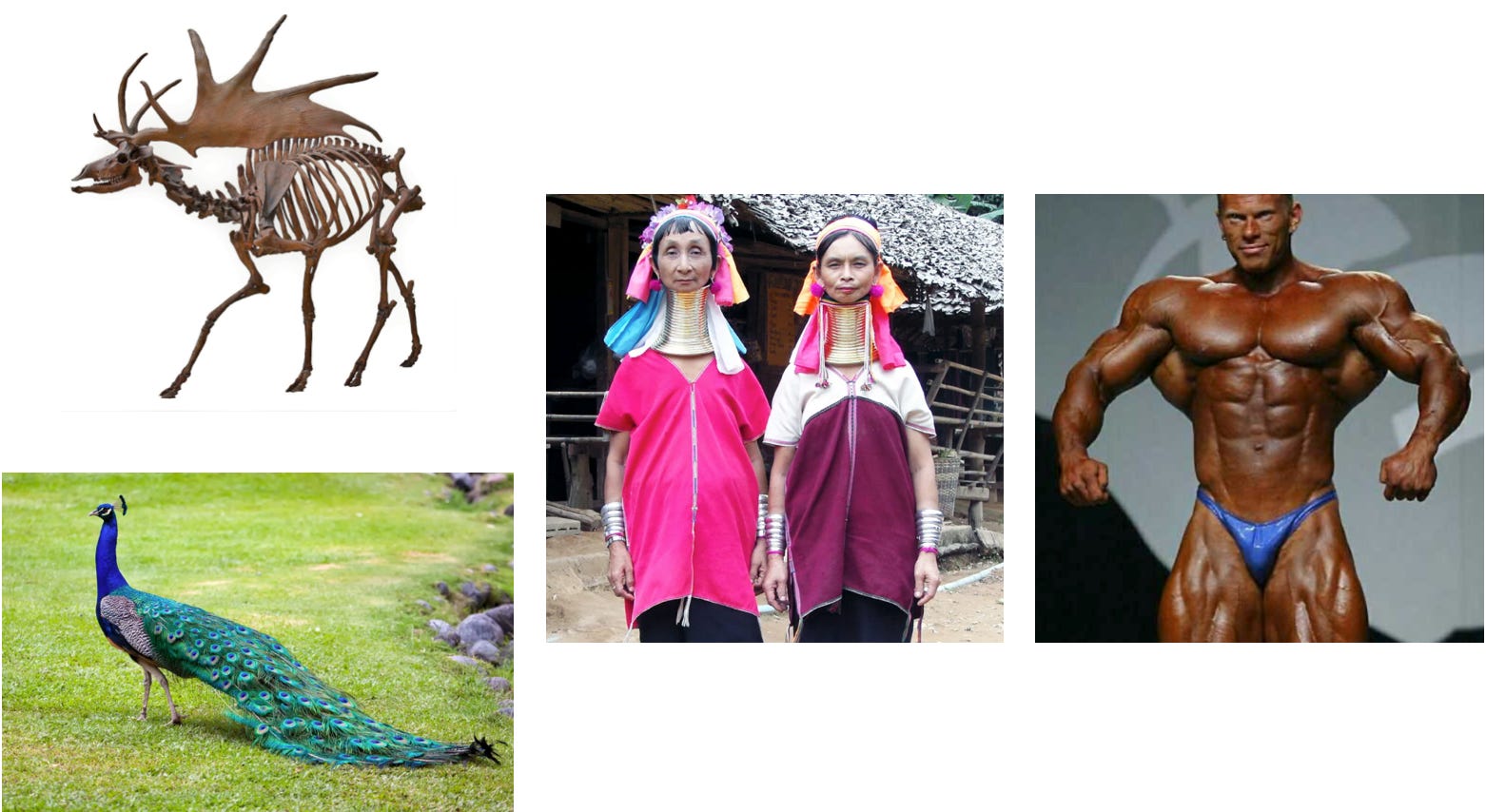
There are differences between animals and humans with respect to these internal value recognition examples. With animals the adaptations become genetic, with humans they are bodily adaptations based on choice and are not passed on to offspring. Still, it is useful to recognise the concept of value recognition within the biological level and how it can be disconnected to the historical morality (purpose) of the biological level.
There are instances where humans have developed physical adaptations over generations. Tribes living at high altitudes in the Himalayas have a different blood structure that allows a higher efficiency in oxygen utilisation compared to lowlanders. However, this is not the kind of value pursuit indicated by the sixth law. This is not a value that is recognised within a tribe and acted on.
Let us now consider the Social level. The morality of the social level is to ‘coerce’ its members into behaviour that ensures the survival of the social value pattern and in turn enhances the survivability of its members. Codes of conduct arise in a social setting that allow the community to function as an entity. These codes are enforced more or less collectively and deviant behaviour is usually punished by some kind of exclusion from the group. This exclusion can be physical but can also mean relegation to a lower status in the groups hierarchy. In the animal world there will often be an alfa male or female that leads in code enforcement. Human tribal life equally has produced leadership structures. This is all very close to the historical morality of the social level.
However, history shows that at some point simple tribal organisation appeared to morph and the tribe started to recognise and pursue values that would seem to present a burden on that society. What to think of the construction of the Giza Pyramid 4600 years ago? Or the colosseum in Rome, 80 AD? Or the Eiffel Tower 1889? These spectacles seem to be driven by authority, ritual and cohesion. They reinforce hierarchy, identity and cohesion and can so strengthen the social pattern. But it would seem prudent to consider that social value patterns can prioritise symbolic cohesion, status, or identity to such an extent that they strain or destabilise the system that sustains them.
The social level organises human behaviour through shared norms and enforcement mechanisms that stabilise group life. However, social systems can develop value pursuits—such as monumental construction or large-scale spectacle—that prioritise symbolic cohesion, status, or identity over material efficiency. While these pursuits may initially strengthen the social pattern, they can also lead to overextension or instability.
Many books have been written on the rise and fall of civilisations, empires, countries, corporations and enterprises. What the MoQ offers as an analytical tool, are formal recognition within a logical system of the following four concepts; (1) recognition of static value patters of the social level, (2) recognition of the morality (historical purpose) of the social level and (3) recognition that a balanced interaction of Dynamic and Static Quality is necessary for survivability and (4) recognition that alternative (deviant) value pursuits can alter and possibly destabilise the social level.
Pirsig states that up until WWI in Victorian society, social codes dominated the intellectual level. After WWI Pirsig argues that progressively intellectual value patterns started to assert themselves on society. Or more accurately; Society started stabilising ideas that before would have been suppressed and filtered out.
Let us now consider the the level of the Intellectual value patterns and what it has developed into. The name ‘Intellectual Level’ sounds very academic but it actually predates science and philosophy. Pirsig states;
“The intellect’s evolutionary purpose….It’s historical purpose has been to help society find food, detect danger and defeat enemies……..The fundamental purpose of knowledge is to dynamically improve and preserve society.”
In chapter 12, I summarised this with the statement; Intellectual value patterns dominate social value patterns by “injecting” into society ideas (Dynamic Quality) that impact the viability, development and progress of that society.
In millennia past the Intellectual level would produce such ideas as spears to improve hunting, clay pottery to hold water and sewing to make clothes of animal hides to protect against the elements, as well as control of fire and many other concepts. This obviously improves and strengthens a society. This can also lead to adaptations in the social value patterns in ways that allow that society to exploit the new idea in the best possible way to strengthen the society. The series of ideas that lead humans to an agricultural existence, transformed hunter gatherer social value patterns to farming social value patterns with all the accompanying consequence. The time scale in which this transformation happened is measured in generations. The people and tribes could gradually form and become accustomed to the new social codes.
Pirsig goes on to explain that Intellect then proceeded to grow away from its original purpose. It became an end in itself. The intellectual level is now no longer only generating ideas that improve the survivability of the society. To be more accurate; Dynamic Quality generates the ideas and Static Quality stabilises the ideas. The societal level is no longer only stabilising ideas that improve the survivability of the society. Today, the Intellectual level is concerning itself with such lofty goals as discovering of the meaning of the universe.
There can be a comfortable symbiotic arrangement whereby the intellectual level by and large coexists with the social level by limiting itself primarily to science and technology and “accepted” art forms. Since ideas originate in a person and since a person’s behaviour is controlled by society, intellectuals can be compliant by filtering out ideas that would contradict existing static social codes. This operating principle assures a peaceful coexistence. Intellectuals and scientists go to church on Sunday and propose knowledge that passes the criterium; is it useful for society? Pirsig states;
“Intellect can support static patterns of society without fear of domination by carefully distinguishing those moral issues that are social-biological from those that are Intellectual-social and making sure there is no encroachment either way.”
Pirsig points out that this is what characterised the Victorian society. France created a different history.
Before the French Revolution, French society was dominated by absolute monarchy and feudal privileges, all but smothering Dynamic Quality from expressing itself. The Dynamic ideas of the Enlightenment summarised as Liberté, égalité, fraternité sought to abolish the existing social value patterns of absolute monarchy and feudal privileges, establishing popular sovereignty, individual rights, and legal equality. Key dynamic ideas of constitutional governance and secularism were institutionalised (stabilised) in society. It was a violent transition but it lead to a more vibrant society that included mechanisms to accommodate Dynamic Quality. The Intellectual level challenged the social level and a transformation of the social codes took place.
Now Pirsig tackles a delicate issue that is another manifestation of the sixth law with respect to the biological level. We have previously seen that the social level organises human behaviour through shared norms and enforcement mechanisms that stabilise group life. We have also seen in the case of the French Revolution that ideas can fundamentally transform the structure of societies. In both these cases, the fundamental building blocks of society did not change. Men and women consistently pursued their struggle to stave of starvation and death, and in general terms endeavoured to improve there material well being. Pirsig now identifies that after WWI new ideas on the biological level (new value pursuits) started to find stabilisation. Alcohol, drugs, Jazz, provocative fashion, promiscuity, hippy movement, sexual orientation and many other manifestations that reflected a search for identity of the individual found ‘stabilisation’ in society. The question; “what is a women?” has been discussed at the highest levels of government in Western countries.
Pirsig reflects that society now has to deal with a challenge from two sides. The Intellectual level has moral precedence over the social level and can inject ideas on the structure and organisation of the society. But since the end of WWI the biological level seems to be progressively engaging in alternative value pursuits. The building blocks of society are transforming. How is society to deal with this double challenge? What influence will this have on the functioning of society?
In this chapter Pirsig looks at modern American society. He makes a sociological analyses of American society from after WWI up to around 1990 when LILA, an Inquiry into Morals was published. He uses the MoQ as a bases for his analyses. He focusses primarily on the above mentioned tensions of our modern time. It is a interesting read from an sociological perspective.
The main take away is that the MoQ offers a comprehensive frame work from which to approach sociological analyses. In our current valley of thought we lack clarity on the concept of Dynamic Quality. We lack clarity on the hierarchy of levels of Static Quality and we lack the concept of value and morality in an evolutionary structure. All this is provided by the MoQ and it represents an extension of rationality.
Chapter 25 - Pirsig returns to the boat
Pirsig arrives at the marina and finds Lila waiting on the boat in the rain and the cold. Lila acts crazy. Pirsig interacts with her and realises Lila is going crazy. Pirsig reviews his own memories of the time he spend in a mental institution. He contemplates how to get rid of Lila but realises he is stuck with her. A chapter with the feeling of nausea, remorse and self-contempt accompanying the degenerate activity of writing a metaphysics.
Chapter 26 - William James and insanity
This is a long chapter where Pirsig first introduces the Harvard Philosophy professor William James who is a respected member of main stream American philosophy. Pirsig’s first book lead to several commentators drawing parallels between James’s and Pirsig’s thinking. This was good news to Pirsig because it could give status to and help with the acceptance of his work.
Pirsig then goes on to interpret and explain in great length the character and meaning of insanity by applying the MoQ.
Pirsig then discusses the phenomenon of cultural filtering that prevents us from seeing things that do not fit in the culture. He translates this to the MoQ by stating that static societal value patterns filter out new Dynamic ideas. This corresponds to our experience. It is part of the tension between saving tradition while pursuing progress. The MoQ offers a solid framework to contemplate these tensions.
Chapter 27 - Escape to Sandy Hook
Chaotic scene at the dock and Pirsig makes a get away from the marina. He escapes to Sandy Hook on advice of Rigel who was part of the confusing situation.
Chapter 28 - Motoring and sailing to Horseshoe Cove
Motoring to Horseshoe Cove on Sandy Hook and recounting memories of his youth and the different times he had visited New York. Pirsig goes for anchor in very quiet Horseshoe Cove. Lila has not emerged from the fore cabin.
Chapter 29 - More Willem James and insanity
Lila in a trance and and does not respond to Pirsig’s questions. Pirsig providers her with some food and drink and leaves her to rest. He gives a long consideration of what insanity is. He then goes over different scenarios of what might happen to Lila.
Pirsig then settles into the cabin and goes about reading and answering many letters. When he is tired of that he decides to read up on Willem James’s philosophical work. Pirsig compares James’s work to the MoQ and comes to the conclusion that the MoQ is an extension of North American philosophy.
Chapter 30 - Going for groceries
Pirsig rows to shore in the dingy to buy food in a nearby village. He then proceeds to meticulously describe all the waste and debris that has washed up on the deserted beaches of Sandy Hook. Is this in reference to the “debris” he is creating by, if not defining, then at least describing Quality? The same Quality he defended and protected agains any kind of definition in his first book?
If not, it is at least a very fitting introduction to the following paragraphs. Pirsig now goes on to describe the nature of insanity and with it he seems to be describing the source of Dynamic Quality. Maybe not so much the source of Dynamic Quality but the appearance of it in relation to humans. It is beautiful and insightful reading but I will not spend time on it. For my intentions it is sufficient to be able to recognise and interpret Dynamic Quality and its interaction with static quality.
Pirsig gets a lift to a grocery store and stocks up on supplies. Then he got a second ride back to the beginning of Sandy Hook and had to walk the rest of the way back to his dingy. During this walk Pirsig discusses a deep historic review of language, almost language archaeology, the goal of which seems to be the validation of the MoQ by historic prospective. At one point the foliage opened up and Pirsig could look out over the Atlantic ocean.
“He stopped for a second by the beach and just stared at the endless procession of waves moving slowly in from the horizon…… “Vast emptiness and nothing sacred.” If ever there was a visible concrete metaphor for Dynamic Quality this was it.”
This is a phrase that throws its shadow ahead to the last chapter. Especially the words nothing sacred are noteworthy.
Chapter 31 - Lila leaves
On return from his grocery trip Pirsig notices that Rigel has come along side his boot. Rigel comes to shore and the two talk about Lila. Rigel fills in some back ground on Lila. Then Rigel tells Pirsig that Lila has decided to go back with him. She is already on his boat. Two days ago Pirsig had ask Lila to leave the boat so one would expect he would be OK with Rigel taking Lila off his hands. He has only known her a few days. But Pirsig is upset and wants to talk to Lila. It is obvious there is no love lost between these two gentlemen. Pirsig goes to Rigel’s boat and has one last talk with Lila but it is clear she does not want to stay with him.
And then we find out that Lila’s last name is Blewitt, as in; she ‘blew it’. And Rigel of course is close to the word ‘Regal’ indicating Victorian respectability (pompousness?). I usually find it tacky when writers choose names with meaningful references but I have so much admiration for Pirsig that I will disregard this.
More important and in line with the MoQ one can ask; what value patterns does Rigel represent? The gravitational pull of established social patterns feels close. Regal Victorian respectability comes to mind. And Lila’s value patterns? She was pursuing Dynamic impulses and Pirsig was, after considerable hesitation, willing to accommodate her. But perhaps under the pressure to survive (sustain biological value patterns) she gave up and lapsed back into established social patterns. Lila Blewitt.
This is all pure speculation of course. It’s like looking at abstract art and thinking you can make sense of it. Its unscientific, it serves no purpose and its quite tacky so I do apologise.
Chapter 32 - Conclusion
We have reached the final chapter and so we prepare ourselves to part with this remarkable book.
Pirsig is now alone again on his boat and Lila’s departure and the circumstances around it are an emotional blow to him. His mind is processing all the different things that happened and things that have been said. He then goes on to characterise Lila;
“The thing that was most attractive about her was that straightforward, eyes-ahead look of someone who’s honest to themself, whatever others might think. Now that’s gone. It meant she was turning back to the static patterns she came from. She’s sold out. The system beat her. It’s made a crook out of her at last.”
Lila Blewitt; the speculations I indulged in about her name seem confirmed. Pirsig then recites a famous poem about Nirvana;
While living,
Be a dead man
Be completely dead,
And then do as you please.
And all will be well.
Pirsig then uses the MoQ to offer a possible translation;
While sustaining biological and social patterns
Kill all intellectual patterns.
Kill them completely
And then follow Dynamic Quality
And morality will be served.
This shows the versatility of the MoQ. It also validates the MoQ. The poem makes no sense when viewed through the concepts of our current valley of thought. But the centuries old poem obtains meaning when it is approached through the framework of the MoQ. It improves our understanding of the poem. The MoQ “explains more of the world and explains it better”.
Pirsig continues processing what has happened to him the last week and gradually becomes at ease with it. He then see’s the trays and the slips containing all the notes for his new book and considers what to do with them. He is emotionally not in place to be productive with the book project. He has always had doubts about his endeavour. Now, his heavy heart allows him, in superb fashion, to express once again his doubts to us;
“Strictly speaking, the creation of any metaphysics is an immoral act since it’s a lower form of evolution, intellect, trying to devour a higher mystic one. It is wrong when a metaphysics tries to devour the world intellectually. It attempts to capture the Dynamic within a static pattern. But it never does. You never get it right. So why try?”
Then Pirsig notices the naked plastic doll that Lila had “adopted” but now left behind. He considers what to do with it. He finds a brand new shirt Lila had intended to give to him, but Pirsig is confused and does not realise it was intended to be a gift. He puts the shirt on the doll and is satisfied with the appearance.
Pirsig eventually decides to dispose of the doll in a ritualistic way. This will help him work through this emotional event of Lila leaving. But there could also be deeper symbolism in his ritual. Pirsig rows to shore in the dinging and follows the beach to an old broken down abandoned fort. He finds his way through the structure to the end of a tunnel at the edge of the sea. It is low tide but at high tide the tunnel will be submerged. He sits the doll up agains the wall and says fair well to it. When the tide comes in the doll will be swept to sea. When Pirsig exits the fort he feels an enormous sense of relief and freedom.
Now consider this. The MoQ is Pirsig’s child. The MoQ has been finalised and is ready to be published and presented to the world. Interpreted by the principles of the MoQ, we now must accept that the MoQ is…… a static intellectual value pattern proposed by a mere mortal. Static intellectual value patterns are not imperishable and therefore have no permanence. Permanence is within the domain of the Gods. (ZAMM chapter 29)
In chapter 30 Pirsig noted about the sea;
““Vast emptiness and nothing sacred.” If ever there was a visible concrete metaphor for Dynamic Quality this was it.”
Does the doll symbolise Pirsig’s child; The Metaphysics of Quality? Just as the doll will be swept out to sea, so too will the MoQ now be exposed to the full influence (eroding force) of Dynamic Quality.
Over the years I have spent countless hours contemplating Pirsig’s thoughts and the MoQ. To read this last chapter and interpret this gesture with the doll could almost bring tears to my eye’s.
Pirsig then circles back to where it all started, the North American Indians. He tells a tale about a dog on the Indian reservation. This tale has become so anecdotal in our family that if, for instance, my son would ask me; “what kind of coffee are you having dad?” I will answer; I am having Good coffee. Good is a noun.
I now make a deep bow to Pirsig for the achievement of writing this book and articulating the MoQ. Writing a metaphysics is already a gargantuan enterprise. Adding into that this incredibly complex story line with the sail boat and Lila……. It leaves one at a loss for words. I find it hard to contemplate that such a man was alive in my life time.
Ton Coumans, June 2026